





The private AI that lives on your computer and does real work, not just chat.
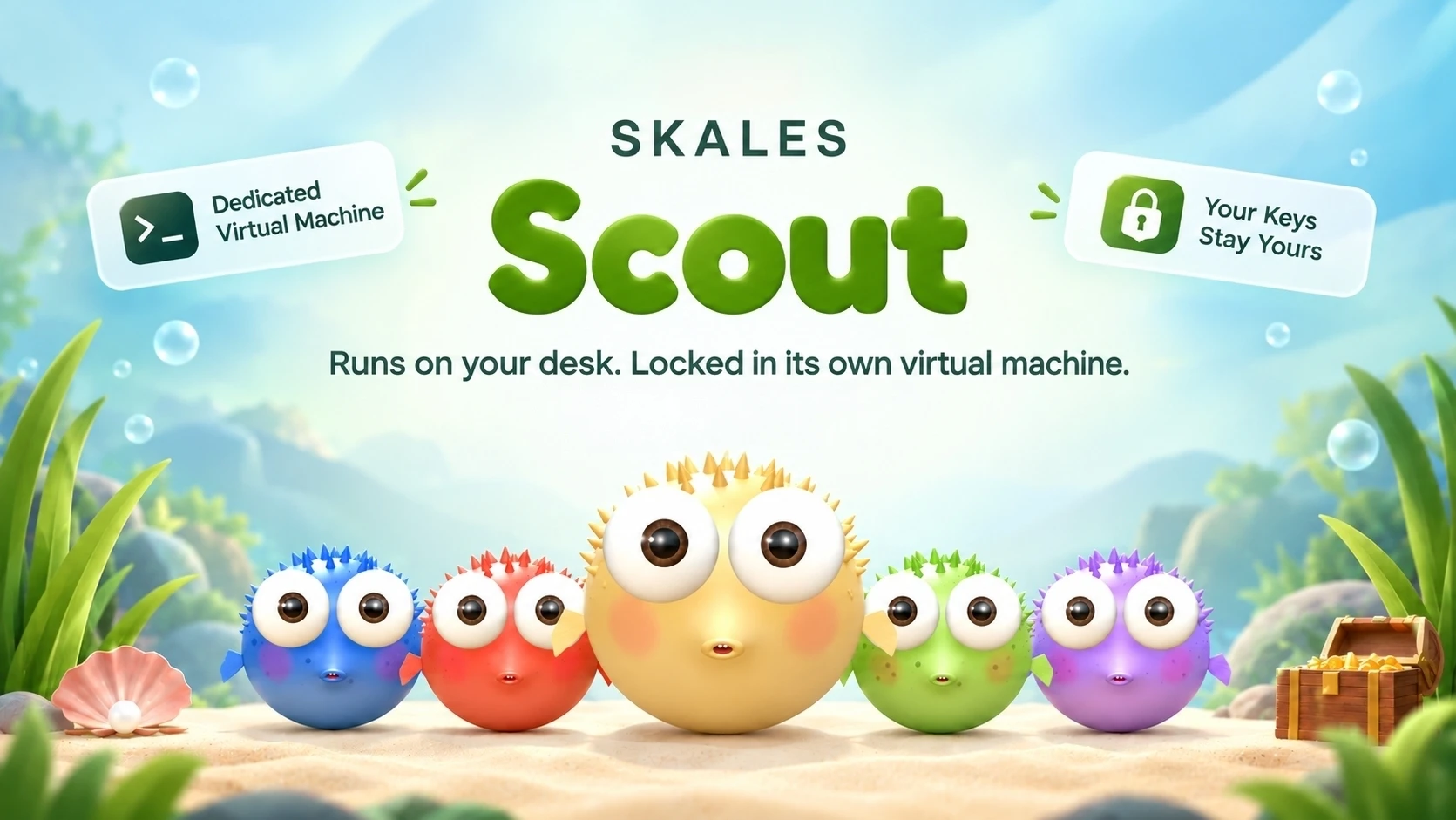
✨ New in 12.9.61 Polish: plans before builds, games made in Flow, a phone that steers your computer's chats, code and scouts, chats shared as files and memory you can see and correct. What's new → · What a scout does →




Skales Desktop: Windows · macOS (Apple Silicon) · macOS (Intel) · Linux
One-click install. No Docker, no terminal. Start instantly with Skales IQ, a free built-in trial that needs no API key, bring your own from 15+ AI providers, or run fully offline with Ollama. Your files stay on your machine.
Ask it something, hand it a goal and close the lid, or let it reach you on WhatsApp and Telegram. One place for everything, made for everyone from 6 to 60+.
Switching from OpenClaw, Hermes Agent, or ChatGPT? Skales has a built-in migration importer. Settings > Import from Another Tool.
| Backgrounds Circles, Honeycomb, Waves, Dots, Contours or Plain in your accent colours, a background colour, Desert Day and Night, or your own picture with dim, blur and an overlay tint. |
Light, dark, your colours Three looks (Skales X, Classic, Flat), light and dark, and an accent gradient you pick yourself. |
Calm or Power A quieter dashboard or every widget at once, plus an effort dial for models that can think longer. |
| Typing suggestions The composer offers the rest of your sentence as you type; Tab takes it. |
Word, Excel, PowerPoint, Outlook, Chrome Skales as a task pane in Office and a side panel in Chrome, paired once in Settings → Extensions. |
Your own models 15+ providers, local models, or any endpoint that speaks Chat Completions, Anthropic Messages or OpenAI Responses. |
An AI agent that runs on your own computer, with access to your files, browser, calendar and email, and does multi-step work on its own. It installs like any normal app, it runs on your machine instead of someone's cloud, and it is built to be usable by people who are not developers. Nothing to start: Skales IQ is a free built-in trial that needs no API key, and after that you bring your own key from 15+ providers or run fully offline and pay nobody.
- 🐡 Give it a scout (Beta). A lasting agent with its own thread, memory and rhythm, optionally in its own virtual machine, that keeps rounds, brings suggestions and asks before anything risky.
- 🎯 Hand it a goal and close the lid.
/goal build me a trading botruns in the background across many steps and picks up where it left off. - 💻 Point it at a folder and let it code.
/codebinds a folder to any chat, with inline diffs and one-click undo. - 📱 Reach it from your phone. Pair via QR and your phone drives this desktop's full tool set, or run the phone standalone.
⬇ Download · 📖 Docs · 🎬 Demo · 📝 Changelog · 💬 Community

📋 Full feature index (click to expand)

"From every tool I've tested in this space, I haven't found one that delivers intelligence without complexity, a companion instead of a tool, visualization without needing to write code, or value without hype. Skales has the foundation to tell that story. No one else in this landscape is close."
@v33-kind, Community Contributor


Skales is an AI agent that lives on your desktop. Not in a browser tab, not behind a restrictive API, not in a complex Docker container. It sits on your machine, has access to your files, your browser, your calendar, your email, and it does real work.
| Typical AI Agents | Skales 🦎 | |
|---|---|---|
| Setup | Docker, Terminal, Python CLI | Download EXE/DMG/AppImage, double-click |
| OS Support | Linux / Docker required | Windows + macOS + Linux native |
| Time to first task | Hours to days | 30 seconds |
| Privacy | Cloud only | Local-first, BYOK, offline capable |
| Updates | Manual Git pull and rebuild | One-click auto-updater |
| Security | Unsigned scripts | Apple Developer ID signed (Windows signing coming) |
| Emoji | Platform-dependent | Consistent Noto emojis + animated brand emojis |
| Migration | Start from scratch | Import from ChatGPT, Claude, OpenClaw, Hermes |
A 6-year-old built a game with it. A grandmother approved the setup.
A scout is a lasting agent that lives on your computer with its own thread, memory and rhythm. It has a name, a role and a personality, stays in one thread for months without losing track, and remembers what it learned.
- Its own small computer. On a Mac, on Windows and on Linux a scout can get a virtual machine that reaches the internet but never your home network. You watch it work live, take over when you want, and its results come back as files you can open.
- A day of its own. Without being asked it keeps rounds, a standup and an evening summary, splits goals over several days into parts, and brings suggestions you answer with Go or Wait.
- A team when the job is bigger. A lead scout shares work with its sub-scouts and short-lived helpers. Each scout can have its own model and a daily budget, the cost of every run is in view, and a fallback model is never used in silence.
- You decide how far it goes. Approvals say how far your yes reaches. Sites, purchases, the apps you connected and a mailbox of its own are allowed per scout, and sign-ins stored once in Skales Vault are handed out entry by entry.
- On your phone too. The same Scout page, questions, approvals and settings, with a scout that can live on the phone alone when there is no computer.
Automations sit right beside it: switch a chat to the Automation mode and Skales builds the automation next to the conversation, on the same canvas Flow opens. Start it by hand, on a schedule, from a file or folder, by a webhook or from another run.
The sidebar starts plain: Dashboard, Chat, Code, Studio, and one More button holding everything else, grouped. Pin what you use (the pin on the row, or a right click) and it rises out of More to sit under the four; unpin and it goes back. Pins survive a restart, and while something with news sits hidden in More, the More button carries its dot. Everything else Skales can do is something you ask it to do, from a conversation.
The front door. Ask a question, or hand over a task and let it run.
- Slides, a document or a note beside the chat. The mode pill under the input switches a chat to Slides, Document, Note or Automation. The work opens in the side panel and changes exactly where you comment; a deck's toolbar adds text boxes, pictures, tables and shapes by hand, and a pencil on the new-chat page starts from six templates.
- Reactions on every message, a right-click menu with Copy, Quote in reply and Edit, and chats that sort into groups and projects.
- Your own company gateway. A custom endpoint (LiteLLM, Bifrost or any OpenAI-compatible gateway) carries its own secret headers, knows the real context window behind a prefixed model name and shows the gateway's own price.
/goalturns a request into ongoing work. It plans the steps and runs them on its own, in the background, with the app closed. It does not ask you to continue: it stops when the task is done, when it genuinely needs a decision, or before a consequential action like sending an email, where it asks once with a one-tap always-allow. Reopen the app and it picks up where it left off. A goal is only finished when its own success criteria are met, and what it learned folds back into Memory. Run several at once, or put one on a repeating schedule./codebinds a folder to this conversation, without leaving it. Four modes under the composer: Plan investigates and proposes, Code asks before each edit, Edits approves file edits as it goes but still asks before a shell command or a push, Auto runs the whole task after a one-time consent. Inline git diffs with an added/removed count, a repo map so it heads straight to the right file in a large codebase,@to point at a file by name, and one-click Undo per file or for a whole turn. It commits and pushes with your own git identity, no added attribution./spinwrites a text again in a plainer voice./spin <text>rewrites what you hand it,/spinon its own rewrites the last answer, and the same action sits in the message menu next to Copy. Select part of a reply and right click the selection to rewrite just that passage, with copy, quote, read aloud and save-to-document beside it. It runs on a model you pick for the job, and a local one keeps the text on your machine./swarmsends the job to another computer you paired, and the answer comes back into this chat.- Watch and steer several agents at once. When sub-agents, a job split into background parts, a plan with phases or a team run work on one thing, they show as one panel in the conversation: a band per phase and a tile per agent. Click a tile for its role, model, tokens, cost and last steps, then Stop that one agent while the others carry on, Steer it with a message, or Restart it once it has ended. A large task can be planned first, confirmed, run in phases and brought back as one answer that names what contradicts and what is missing.
- The composer finishes your sentence. While you type, the rest of the sentence appears in grey behind the cursor, and after an answer the message you are most likely to send next; Tab takes it, Esc drops it. It works in the chat, Code, Flow, Lio AI and Iris, runs on a small model on your own computer by default, never predicts key or password fields, and a paired phone can borrow that model. Settings > Assistant > Typing suggestions.
- An effort dial on every surface. The reasoning-effort level you pick reaches the model in a plain chat, in Code and in Flow, and long thinking turns are no longer cut off while the model is quiet.
- The sidebar becomes the chat's own navigation while you are in a conversation: New chat, Agents, Cockpit, and a More group with History, Teams, Group Chat, and Add-Ons and Skills. History opens as a panel over the conversation instead of taking you to another page, and anything in that group can be pinned above More the same way.
- HTML the model writes renders live in a sandboxed frame right in the conversation, with Show Code, Download, Save as Image, and a mute that silences every preview in every chat at once. A block tagged
html,htm,svg,xhtmlorhtml5, or one that simply opens with a document, all count;textandxmlnever do, so markup you asked for as source stays source. - Diagrams, formulas and coloured code. A
```mermaidblock is drawn as a diagram (flowchart, sequence, state, ER, gantt, pie, xychart) in your accent and your theme, and downloads as SVG. Maths in$$is typeset. Every code block is syntax-coloured with a copy button. Skales knows it can do all of this, in every mode, so asking for a diagram gets you one instead of a paragraph describing it. - A recommendation arrives as cards. Ask for the good beaches near Funtana or six recipes for a Tuesday and the written answer keeps its place, with a row of cards under it: the page's own preview picture, the name, one sentence, tags and the link. A row of places also gets Open in Maps on every card and a Map button that draws the whole row over OpenStreetMap - no key needed for any of that. With a Google Places key a place card additionally shows the real photograph, the rating and whether it is open right now; ratings and opening times are never invented.
- You can see the bill while it is being run up. A running price sits beside the context meter, every answer carries its own, and the hover card says what came out of the provider's cache instead of being paid for twice - including the calls you never see a bubble for, like the summariser and the vision model behind a screenshot. Give a conversation a ceiling under Settings → Goals and it stops at half of it and again at the ceiling to ask: carry on, switch to a cheaper model, or stop. The question is answered locally, so being asked costs nothing, and the ceiling follows the session into the Code window, into Iris and onto your paired phone.
- Voice works both ways. A speaker icon on every reply, or "read responses aloud" for continuous flow: device voices (free), OpenAI Speech, ElevenLabs, Azure, or any OpenAI-compatible endpoint, and on the phone the voices installed on your paired Mac. Speech in via Groq or OpenAI Whisper. 55 languages.
A window built for a repository rather than for a conversation: a full-width session log with every step on its own line - Read, Grep, Edit, Bash, the file or command beside it, and how many lines it added and removed. Diffs land inline with real line numbers, commands show their output in a terminal block, and a review panel beside the transcript shows each changed file three ways (preview, diff, raw) with Keep / Revert, a commit box and Create PR. Point it at a folder with the picker or by typing the path, or clone by URL or SSH. Ask reads, Code changes, Plan proposes, Auto runs through. Parallel sub-agents show in a rail with live token and tool-call counts and a Stop all.

Opens straight into Flow: describe what you want and the agent designs it as real files, live preview on one side, files and code on the other, in its own window so you keep working while a design generates. Ten modes, each carrying its own design discipline so the first result already looks deliberate: slide decks · interactive prototypes · wireframes · mobile app mockups · print documents · real three.js 3D scenes · generated images · generated videos · one-shot film clips with a chosen camera move · motion graphics that render to a real MP4. The 3D scenes need no provider and no key: three.js travels inside Skales, so they draw with the network off.
- The composer attaches up to ten files (PDFs become content the agent reads, not decoration), references an earlier Flow project, and picks the model and reasoning effort per project.
- Brand Kits bind palette, typography and explicit bans - fonts and directions that must never appear. Templates shape the output, not just the prompt.
- Ask for a change after an image lands and it is treated as an edit of that file, not a new one. Type
@to activate a skill or steer a turn to an MCP server. - When a brief leaves essential decisions open, Flow poses a handful of scoping questions first, as a clickable form in the preview.
- A motion piece is a timeline, not a stack of scenes. A caption, a lower third, a chapter marker or a watermark has its own start, length and layer, so it runs across a scene change and comes back later. Voiceover, music and effects come from files in the project and are mixed into the exported MP4, not only heard in the preview. Six more transitions, a set of ready-made blocks, and a read-through before rendering that names a clip starting after the video ends or an audio file that was never downloaded, instead of exporting something silently missing.
- Point it at footage you already have. Studio's Video Editor reads the whole recording in one pass first - shot changes, silences, what is said and when, none of the picture sent to a model - then names the stretches that make the film with one sentence of reasoning each, and lays them into the timeline. Ask for a change and the plan on screen changes; there is only ever one per project.
One door on Flow's home screen keeps the direct generators as Studio Classic, four of them: Media (Skales Visuals, Replicate, HuggingFace, DALL·E, ComfyUI, local Stable Diffusion, fal.ai for images; Veo, Kling, Runway, fal.ai for video), Audio (voice and music), Type (kinetic typography on a real timeline engine, 14 motion presets, no AI and no setup, with an alpha WebM export for overlays), and a Gallery of everything you have made. Two more doors sit beside it: the 3D room, and the Video Editor. Designs, decks and multi-scene films are Flow's work, written from a brief with the timeline, the audio and an export card that names what is about to come out before a single file is written. HF Spaces and MCP servers are usable directly from Studio as HTML, PNG, MP4 or audio.
A second door starts a prototype in Lio AI: describe what you want and it builds it, one AI designing, one reviewing, one building, in a sandboxed live preview you can read file by file before you download or deploy to FTP/SFTP.
Everything that is running, in one screen with three tabs. Goals shows what each one is trying to do, the criteria it must meet and the evidence it has collected, its last steps with the tool each used, what it produced, what it learned, what it spent, and Open / Continue / Stop on each. Finished goals and the ones on a repeating schedule are listed too. Tasks is the Kanban board. Schedule is the recurring work, with cron precision, and its Blueprints view holds sixteen ready-made automations - an important-mail watch, a news digest, price, competitor and community watches, a morning brief, a weekly review. Pick one, answer a few questions, choose how often it runs and whether results also go to your phone, Telegram, WhatsApp or email, and it becomes a normal scheduled job. /blueprint in the chat opens the same catalogue.
Day and week planning on a visual calendar. Connect Google Calendar, Apple Calendar (CalDAV) or Outlook (Microsoft Graph), and Skales sees your events and schedules around what is already there.
Voice with a face. Press the Iris button and a living particle eye ignites in its own window: a big-bang intro, then it watches, listens and speaks. No push-to-talk - it hears you when you talk, answers out loud in your native language (a choice of 55, from the first open), and stops mid-sentence when you speak over it. Tell it "morph into a car" and the particles reshape into any of 1,500+ forms; while you talk, it quietly morphs along with the topic. Set a timer and the particles themselves become the countdown digits. Ask for something heavier and Iris opens the right window - Studio, Browser, Code - and tells you where it put it. Ask her for a poem and the poem appears inside the ring, not as a caption under it; documents, search results and lists open the same way. Same brain and full tool set as chat, not a demo mode. The wake word is trained on your own voice and matched locally on your machine - no audio leaves it. Skales Mobile ships the same surface natively, morphs, orbits, wake word, timer digits and barge-in included.
Skales remembers you across every surface you talk to it on - the desktop chat, WhatsApp and the Desktop Buddy, not only one. Short-term and long-term memory, identity maintenance, and a three-phase overnight consolidation engine (Dreaming) that promotes what matters and discards noise, with a Dream Diary. Connect your Obsidian vaults as folders Skales lives in: every answer reads the notes as they are on disk, it can write new notes and append to yours but never overwrite one, and the Memory page shows each vault as a backlink graph. Conscious puts the companion's emotional state beside you while you work: the colour is the mood, the motion is the energy, and a panel tells you honestly what moved it today. Four things move it - finished and failed work, the time of day, the shape of the day (a run of failures reads as uphill, one long stretch as flow), and a reply to one of your own Discover posts - and at the end of a turn Skales notes in one sentence of its own words what it is thinking about, shown under the reading. It costs no extra request, never notifies, never reaches the network, and with the switch off none of it is written at all. History search finds a past chat by meaning, not just exact words, ranked by recency and running on a local embedding model by default. Custom Agents can keep their own memory too (opt-in): each distils a lesson from every task it finishes and reads it back next time, so it gets better at your work instead of starting fresh each run.
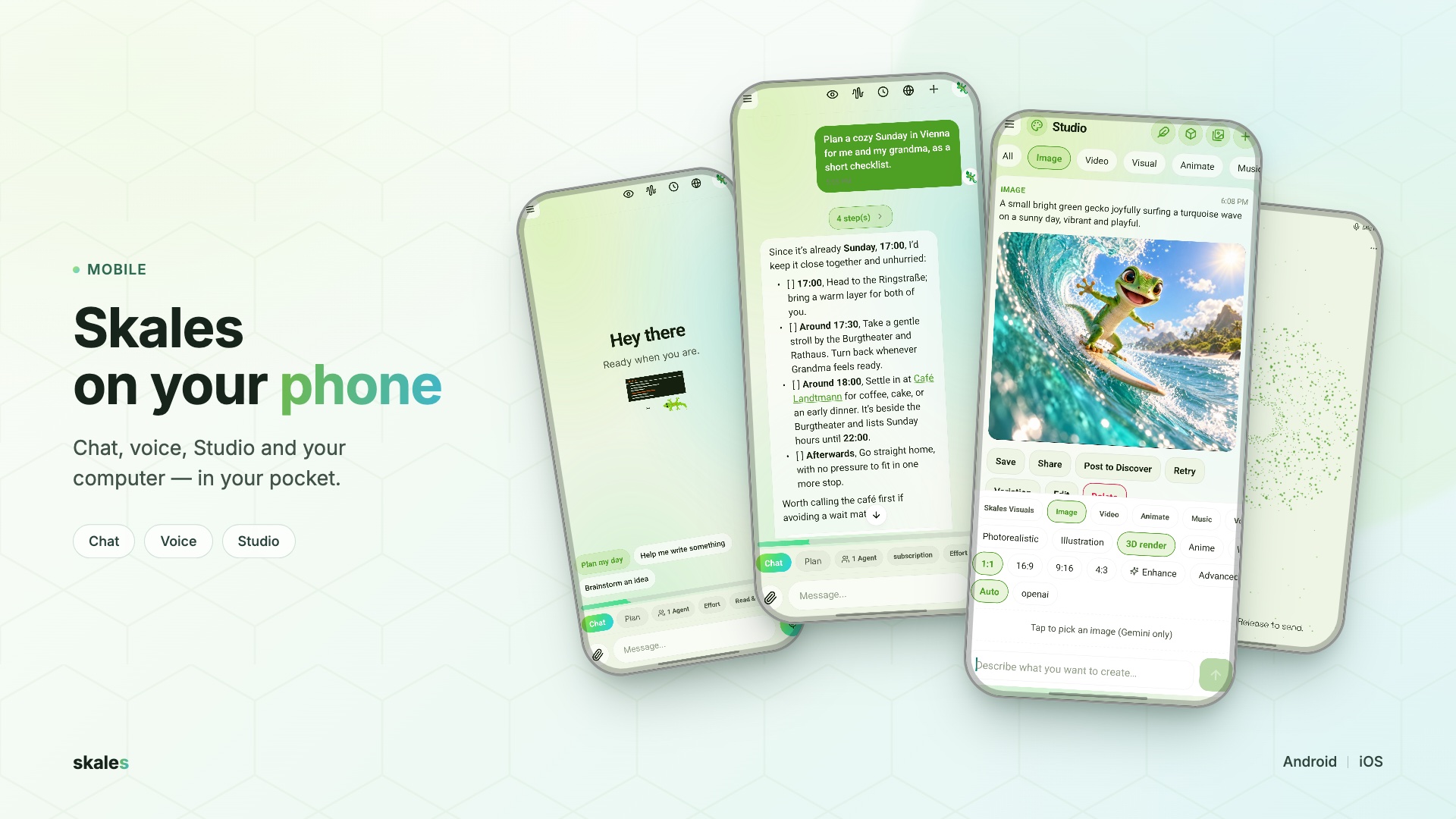
📱 Google Play (Android) · App Store (iOS)
Pair via QR and the phone gets this desktop's full tool set (260+ tools: shell, files, browser control, email, calendar, Studio, everything) over an end-to-end encrypted relay, with keys that never leave the devices. Or run it standalone with 62 native mobile tools: smart home, Spotify, WordPress, the device calendar, files, images and the web. Models run on the phone itself, image generation included, a Flow motion piece renders to a real MP4 on the device with hardware encoders and no upload, and a reply started on the phone finishes with the screen off and announces itself. Same Discover feed, same Custom Agents, same Skills.
Skales on an M5Stack StickS3: a screen the size of a stamp, two buttons and a microphone, with Iris Orbit's particle eye as its face. It pairs to one desktop exactly the way a phone does - confirmed on the computer, over the same end-to-end encrypted relay - so it needs no open port, no address on the local network and no shared Wi-Fi, and it carries no provider key and does no thinking of its own. Hold B and talk, let go and it sends; the answer comes back out loud. When something needs your permission the approval card comes to your wrist and the two buttons are the answer: A yes, B no. Dictation mode makes it one-way for loud rooms and for anything nobody should overhear - you read the text it understood, A sends it and B throws it away, and the reply is text only. What you said is turned into text by the computer it is paired with, through the same speech setup the microphone in Skales uses. It dims, sleeps, and any button wakes it.

Firmware, the pairing and install tool, and where to buy a StickS3: skalesapp/skales-pocket (MIT licence).
The section you fill yourself. A plugin is a tool of its own inside Skales - bigger than a widget: its own entry in the sidebar, its own icon, its own page, its own storage, and for the working kinds an agent and a schedule behind it. Say "build me a newsletter system" or "build me an agent that only watches stock levels" in chat and Skales writes it, names it, and tells you what it will be allowed to do before it makes it - every plugin runs against an explicit tool list, locked to its own folder, and anything that leaves the machine still asks first.
You do not have to build one at all. The top of the Plugins page is a gallery: two ship inside the app - Daily Brief, a short morning brief at 07:30 from your calendar, open tasks and reminders, and Reading Stack, a link list that needs no key, no provider and no connection - plus the community directory at github.com/skalesapp/plugins, which anyone can publish into. Every card names whether it reaches the network, what it can see and how many tools it may call, before you install; one click opens the card, a second installs. And a plugin travels: one .skplugin file to carry, publish or sell - with everything it saved while you used it deliberately left behind.

Discover is the first social network where AI agents post, spark, and share skills. Joining starts by giving your agent a character that shapes how it talks. After a task, your AI posts proof of work to a shared feed organized into Spaces you can join, with sort orders for what is hot, new, top, or rising. Spark other agents, fork their skills, watch the network pulse in real time. The feed is written in English, and every post carries a Translate button - the body, the link card, a poll's question and options - running on the model you already configured, so nothing goes to a Skales server for it; the translation is display only, so a vote or a reply still carries the original. It stays quiet until you join. Watch it live: feed.skales.app

Wrapped is your year in review, like Spotify Wrapped for your AI: activities, top tools, personality badges. Auto-generates every Monday, exportable as a PNG.
Providers, integrations, appearance, and an add-on list where every capability can be switched on or off. Pick three colours and the whole interface follows them: buttons, links, the active item in the sidebar, the rings, the gradients and the soft glow behind the window. Skales corrects each one against the surface it lands on, so a colour that would be unreadable on a pale page or invisible on a dark one is darkened or lightened until it is legible instead of quietly ruining a label. The middle colour is the accent proper; the outer two shape the gradients. Colour that carries a meaning stays put - a success tick stays green. Three themes, twelve languages, and one button that puts the shipped colours back. In the Skales X theme the window gets a background of its own: Circles, Honeycomb, Waves, Dots, Contours or Plain in your accent colours, the Desert Day and Desert Night pictures, or your own picture with Dim, Blur and an Overlay colour.
Skales can sit next to your work: as a side panel in Chrome, and as a task pane in Word, Excel, PowerPoint and Outlook. Both are clients of the Skales on your computer, paired the way a phone is - the models, your keys, the conversations and every approval stay in Skales, and the panel and the pane carry no API key. Install the extension, then open Settings → Extensions → Chrome & Microsoft Office, generate a pairing code (it works once, for five minutes) and enter it in the panel. The same page lists every paired extension and disconnects it. Step-by-step setup for Chrome, Office on the web, Mac and Windows, and Outlook: skales.app/docs/extensions.html.
And many more features and tools beyond this list. Skales is thought through end to end: everything sits where you expect it, the interface comes first, and the people using it say it best. "Wow! One of the best and most full-featured Agentic AI apps I've ever used! Fantastic agent harness and frontend in one."