





Download Installer || Installation || Docker Setup || Silly Tavern || Extensions || Feedback / Bug reports
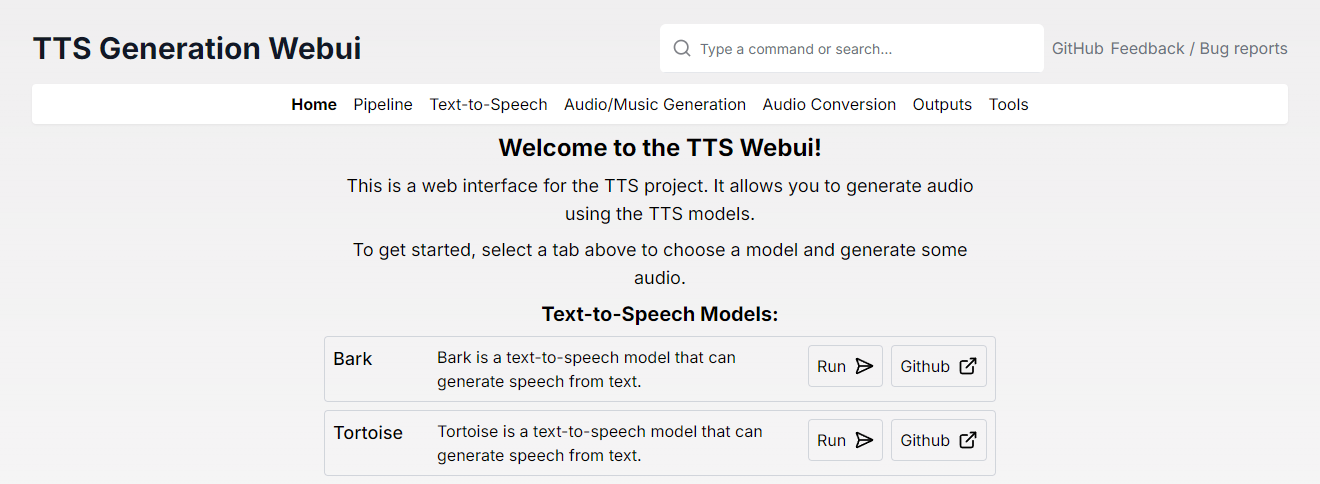






 |
 |
 |
|---|
Bark.Narration.mp4 |
Bark.Japanese.mp4 |
MusicGen.mp4 |
|---|
 |
 |
 |
|---|
 |
 |
 |
|---|
| Text-to-speech | Audio/Music Generation | Audio Conversion/Tools |
|---|---|---|
| Bark | MusicGen | RVC |
| Tortoise | MAGNeT | Demucs |
| Maha TTS | Stable Audio | Vocos |
| MMS | Riffusion* | Whisper |
| Vall-E X | AudioCraft Mac* | AP BWE |
| StyleTTS2 | AudioCraft Plus* | Resemble Enhance |
| SeamlessM4T | ACE-Step* | Audio Separator |
| XTTSv2* | Song Bloom* | PyRNNoise* |
| MARS5* | MiMo Audio* | |
| F5-TTS* | ||
| Parler TTS* | ||
| OpenVoice* | ||
| OpenVoice V2* | ||
| Kokoro TTS* | ||
| DIA* | ||
| CosyVoice* | ||
| GPT-SoVITS* | ||
| Piper TTS* | ||
| Kimi Audio 7B Instruct* | ||
| Chatterbox* | ||
| VibeVoice* | ||
| Kitten TTS* | ||
| Index-TTS2* | ||
| VoxCPM* | ||
| FireRedTTS2* | ||
| MegaTTS3* | ||
| MiniMax Cloud TTS (built-in) |
* These models are not installed by default, instead they are available as extensions.
TTS WebUI Ignition is the new installer and launcher for TTS WebUI.
On Windows:
winget install TTS-WebUI.Ignition
For other platforms, download the latest release from the releases page or build it from source using the instructions in the repository.
Current base installation size is around 10.7 GB. Each model will require 2-8 GB of space in addition.
- Download the latest version and extract it.
- Run start_tts_webui.bat or start_tts_webui.sh to start the server. It will ask you to select the GPU/Chip you are using. Once everything has installed, it will start the Gradio server at http://localhost:7770 and the React UI at http://localhost:3000.
- Output log will be available in the installer_scripts/output.log file.
- Note: The start script sets up a conda environment and a python virtual environment. Thus you don't need to make a venv before that, and in fact, launching from another venv might break this script.
Prerequisites:
- git
- Python 3.10 or 3.11 (3.12 not supported yet)
- PyTorch
- ffmpeg (with vorbis support)
- (Optional) NodeJS 22.9.0 for React UI
- SQLite (bundled with Python) for database support
-
Clone the repository:
git clone https://github.com/rsxdalv/tts-webui.git cd tts-webui -
Install required packages:
pip install -r requirements.txt
-
Run the server:
python server.py --no-react
-
For React UI:
cd react-ui
npm install
npm run build
cd ..
python server.py
For detailed manual installation instructions, please refer to the Manual Installation Guide.
tts-webui can also be ran inside of a Docker container. Using CUDA inside of docker requires NVIDIA Container Toolkit. To get started, pull the image from GitHub Container Registry:
docker pull ghcr.io/rsxdalv/tts-webui:main
Once the image has been pulled it can be started with Docker Compose: The ports are 7770 (env:TTS_PORT) for the Gradio backend and 3000 (env:UI_PORT) for the React front end.
docker compose up -d
The container will take some time to generate the first output while models are downloaded in the background. The status of this download can be verified by checking the container logs:
docker logs tts-webui
If you wish to build your own docker container, you can use the included Dockerfile:
docker build -t tts-webui .
Please note that the docker-compose needs to be edited to use the image you just built.
May:
- Add virtual environment system (uv), preventing extension conflicts.
April:
- Add torchcodec CPU to requirements
- Upgrade PyTorch to 2.11.0
- Update pin TorchAudio to 2.7.0
March:
- feat: Next.js 13.5 → 16.2.1 Upgrade
December:
- Minor bug fixes and improvements
- refactor: extract bark config loading to separate function from WebUI
- chore: remove postgres from tts-webui as it is a heavy dependency not needed for most users
- feat: add database API server to manage generated audio files and metadata
November:
- Add extension marketplace directly in the Gradio UI using iframe
- Move voices-tortoise to voices/tortoise/ (and maha-tts to voices/maha_tts/)
- feat: add comprehensive test suite for tts_webui modules
- feat: implement install button for extension marketplace
- feat: add button to check dependencies in extension management UI
- feat(cli): add extension-manager command to launch GUI tool
- chore: remove uv from google colab
- chore: move logging directory to installer_scripts/logs/
- feat: add ability to disable decorator extensions via config.json
October:
- Update Gradio to 5.49.1
- Update @gradio/client to 1.19.1
- Fix Chatterbox installation issues, paths and streaming errors in Silly Tavern
- Create new extension category - Conversational AI
- Reorganize environment variables, new dotenv manager
- Convert more of the UI into extensions and simplify base server
- Add API_KEY to OpenAI TTS API extension
- feat: support new extensions format - tabsInGroups
- feat: add External Extensions Installer to manage and install external extensions via JSON
- feat: Add links to TTS WebUI Extension Catalog in documentation and installer UI
- feat: Add Log Viewer extension to view and manage log files
See the 2025 Changelog for a detailed list of changes in 2025.
See the 2024 Changelog for a detailed list of changes in 2024.
See the 2023 Changelog for a detailed list of changes in 2023.
Extensions are available to install from the webui itself, or using React UI. They can also be installed using the extension manager or the External Extensions Installer (a built-in tool for adding custom extensions from JSON).
Internally, extensions are just python packages that are installed using pip. Multiple extensions can be installed at the same time, but there might be compatibility issues between them. After installing or updating an extension, you need to restart the app to load it.
For a curated list of community-created extensions, visit the TTS WebUI Extension Catalog. You can also find information on publishing your own extensions there.
Updates need to be done manually by using the mini-control panel:

-
Update OpenAI TTS API extension to latest version
-
Start the API and test it with Python Requests
(OpenAI client might not be installed thus the Test with Python OpenAI client might fail)
-
Once you can see the audio generates successfully, go to Silly Tavern, and add a new TTS API Default provider endpoint:
http://localhost:7778/v1/audio/speech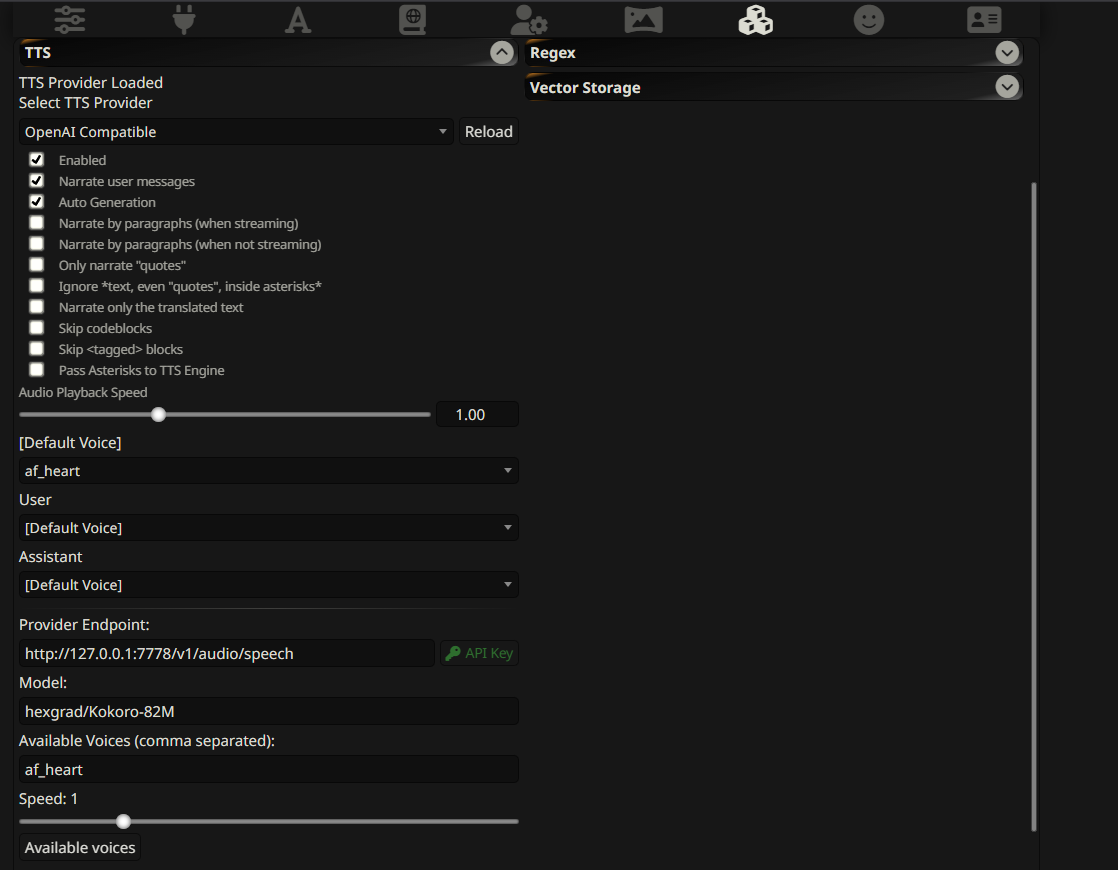
-
Test it out!

- Install https://github.com/rsxdalv/text-to-tts-webui extension in text-generation-webui
- Start the API and test it with Python Requests
- Configure using the panel:
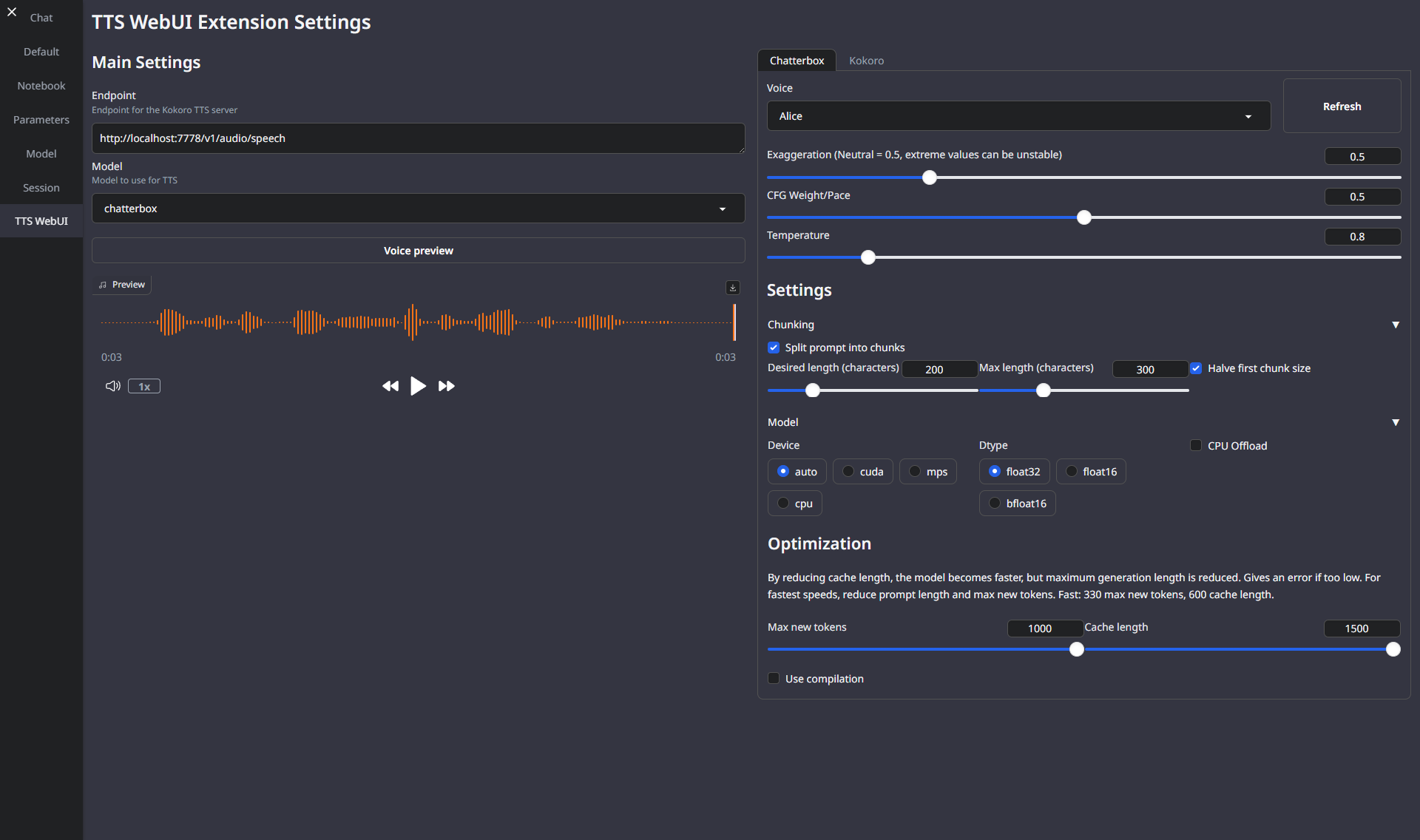

- Enable OpenAI API extension in TTS WebUI
- Start the API and test it with Python Requests
- Once you can see the audio generates successfully, go to OpenWebUI, and add a new TTS API
Default provider endpoint:
http://localhost:7778/v1/audio/speech - Test it out!
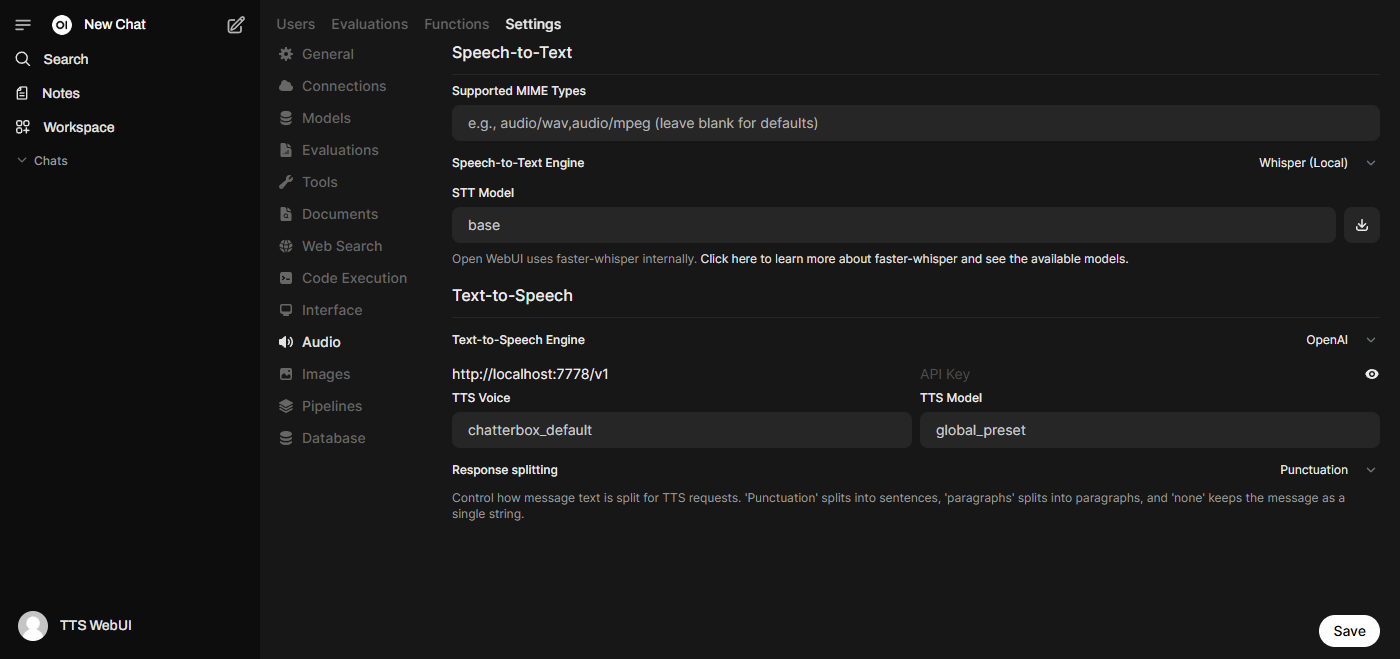

Using the instructions above, you can install an OpenAI compatible API, and use it with Silly Tavern or other OpenAI compatible clients.
These messages:
---- requires ----, but you have ---- which is incompatible.
Are completely normal. It's both a limitation of pip and because this Web UI combines a lot of different AI projects together. Since the projects are not always compatible with each other, they will complain about the other projects being installed. This is normal and expected. And in the end, despite the warnings/errors the projects will work together. It's not clear if this situation will ever be resolvable, but that is the hope.


This project utilizes the following open source libraries:
-
suno-ai/bark - MIT License
- Description: Inference code for Bark model.
- Repository: suno/bark
-
tortoise-tts - Apache-2.0 License
- Description: A flexible text-to-speech synthesis library for various platforms.
- Repository: neonbjb/tortoise-tts
-
ffmpeg - LGPL License
- Description: A complete and cross-platform solution for video and audio processing.
- Repository: FFmpeg
- Use: Encoding Vorbis Ogg files
-
ffmpeg-python - Apache 2.0 License
- Description: Python bindings for FFmpeg library for handling multimedia files.
- Repository: kkroening/ffmpeg-python
-
audiocraft - MIT License
- Description: A library for audio generation and MusicGen.
- Repository: facebookresearch/audiocraft
-
vocos - MIT License
- Description: An improved decoder for encodec samples
- Repository: charactr-platform/vocos
-
RVC - MIT License
- Description: An easy-to-use Voice Conversion framework based on VITS.
- Repositor